home
about
writing
teaching
audio
performance
dramaturgy
I have experience as a dramaturg for movement-based performance, from process to performance. Following Katherine Profeta1, I consider dramaturgy as a practice of oscillation—moving between roles including but not limited to: witness, researcher, translator, transcriber, archivist, reflector, questioner, synthesizer, and more. In oscillating around and through multiple vantage points, I aim to cultivate more understanding of an unfolding process, and a lack of calcification in my own position, knowledge, or opinions. Through this practice, I find it becomes more possible to discover a process’s distinct logic and world-building technique, and disrupt my assumptions, biases, and trainings.
For me, dramaturgy is a mode of creative companionship, prioritizing gifts of time and attention to the unfolding process at hand. Each dramaturgical relationship between myself and a choreographer/director is particular—modes of attention, documentation, and reflection can be tailored to the questions, methods, and lineages in use. I aim to cultivate dramaturgical relationships that can be sites of collaboration and friendship, and where disagreements, problems, and conversations feed creative exploration, research, and co-creation of technique and knowledge.
At the core, dramaturgy is a way for me to practice care, interdependence, collaboration, and investment in creative practices that serve the collective through radical questioning and imagination. Through dramaturgy, I hope to cultivate more abundance, generosity, attention to process, and the proliferation of embodied epistemologies—all in resistance to creative economies that reinscribe myths of scarcity, individualism, and creative product as commodity.
about
writing
teaching
audio
performance
dramaturgy
I have experience as a dramaturg for movement-based performance, from process to performance. Following Katherine Profeta1, I consider dramaturgy as a practice of oscillation—moving between roles including but not limited to: witness, researcher, translator, transcriber, archivist, reflector, questioner, synthesizer, and more. In oscillating around and through multiple vantage points, I aim to cultivate more understanding of an unfolding process, and a lack of calcification in my own position, knowledge, or opinions. Through this practice, I find it becomes more possible to discover a process’s distinct logic and world-building technique, and disrupt my assumptions, biases, and trainings.
For me, dramaturgy is a mode of creative companionship, prioritizing gifts of time and attention to the unfolding process at hand. Each dramaturgical relationship between myself and a choreographer/director is particular—modes of attention, documentation, and reflection can be tailored to the questions, methods, and lineages in use. I aim to cultivate dramaturgical relationships that can be sites of collaboration and friendship, and where disagreements, problems, and conversations feed creative exploration, research, and co-creation of technique and knowledge.
At the core, dramaturgy is a way for me to practice care, interdependence, collaboration, and investment in creative practices that serve the collective through radical questioning and imagination. Through dramaturgy, I hope to cultivate more abundance, generosity, attention to process, and the proliferation of embodied epistemologies—all in resistance to creative economies that reinscribe myths of scarcity, individualism, and creative product as commodity.
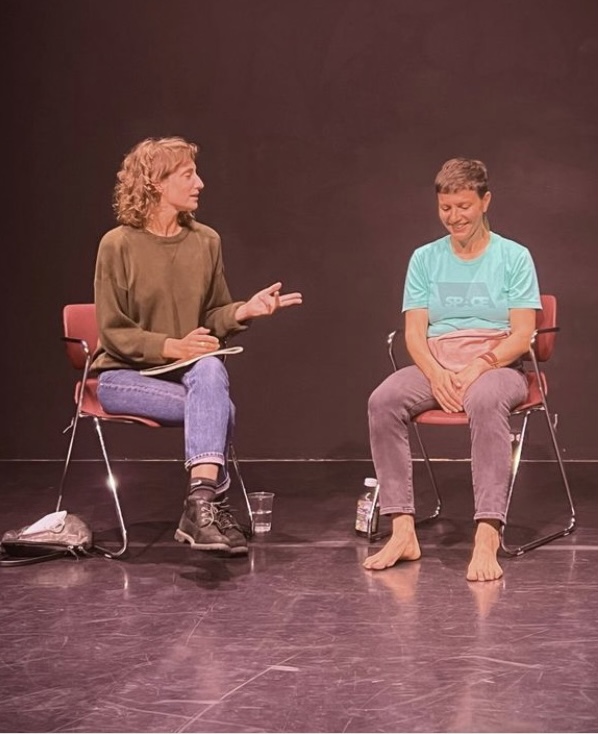
*with Lailye Weidman (right), SPACE, Portland, Maine, November 2023.
1 Profeta, Katherine. Dramaturgy in Motion: At Work on Dance and Movement Performance, University of Wisconsin Press, 2015.